Help
Desk & Support Center
Call Center
Management
Tech Support Resources
Project Management
Contact Center Technology
Online Support
Customer Satisfaction
Knock Your Socks Off
Service
Help Desk Institute
Telecom Books
Communication
Skills
Call Center Monitoring
Metrics & Benchmarking
CRM
Hiring, Training,
& Retention
Outbound Telebusiness
Novelties, Gifts, & Humor
Bargain Books (50% off)
Call
Center Courses
Telephony
Courses
ITIL
& Help Desk Courses
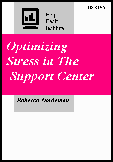 |
Optimizing Stress in the Support
Center by Rebecca Braden Nordeman, softcover, 32 pages, $19.95 |
Stress management has done little to prevent burnout among talented support professionals. But a new approach called "stress optimization" can reduce stress before it hurts people. Becky Nordeman, a support researcher and consultant, explains why controlling stress is good business. You'll discover three attitudes that make individuals and organizations "stress resistant," and learn to cultivate those traits to create a healthy and productive support center.
Table of Contents
-
Beyond stress management
- Why stress management fails
- The two-edged sword
- Stress optimization, briefly defined
-
The war on stress
- Major pressures on the support center
- The casualties: your best support analysts
- Survival of the hardiest
- Creating the hardy organization
-
Building commitment
- Developing a credible leadership
- Establishing a climate of trust
- Contracting for clear expectations
- Committing to share information
- Insuring personal and professional development
-
Building control
- Promoting self-knowledge
- Discussing unique stressors and developing a plan of attack
- Breaking the stress cycle
- Encouraging participation at all levels
- Renegotiating psychological contacts during times of change
-
Building challenge
- Modeling optimistic attitudes from the top down
- Identifying growth opportunities
- Rewarding creative organizational problem solving
- Valuing continuous organizational learning
- Establishing support systems, and "caring harder"
-
Stress is a leadership issue
- Stress is an organizational problem
- A three-step approach optimization
Appendix - Where to learn more