Help Desk Books
Call Center
Management
Automation Aids
Online Support
Customer Satisfaction
Knock Your Socks
Off
Help Desk Institute
Telecom Books
Communication
Skills
Call Center Monitoring
Bargain Books (50% off!)
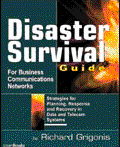 |
Disaster Survival Guide for Business Communication Networks: Strategies for Planning, Response and Recovery in Data and Telecom Systems, 1st edition, by Richard Grigonis, 383 pages, 2002, $49.95 |
Many organizations have begun to have a more focused approach to disaster planning. But in today's perilous climate which not only includes terrorist attacks, but also the usual never-ending onslaught of hackers, crackers, computer viruses, "tele-thieves," earthquakes, fires, floods, lightning strikes, and other disasters, assuring the survivability of your organization is more challenging than ever before.
This book is written specifically for IT system administrators and telecom managers who want to protect their organization's increasingly complicated and diverse telecom and datacom networks, as well as the telephone systems, Internet sites, computers, and data-laden storage devices attached to them.
This unique guide says that managers must take a new approach in protecting their assets. Instead of just implementing monitoring and detection measures with immediate intervention to combat disasters and ensure business continuity, managers should extend and intensify their security planning phase, reducing the possible magnitude of catastrophic incidents in advance by re-engineering their business to achieve a distributed, decentralized, and hardened organization. This can be done using the latest in communications technology (virtual private networks, conferencing technology, and the Internet) as well as networking and managing a new generation of the traditional "uptime" technologies (fault tolerant computer telephony, convergence, and power supply systems).
With such a strategy, network and system administrators can now defend not just their telecom, information, and computing assets to the fullest extent possible, but can equally safeguard their most important asset - their employees.
And whether it's identifying how hackers and crackers find vulnerabilities in your system, how unnoticeable levels of static electricity can shorten the life of electronic components, or how a centralized workforce can cripple recovery efforts, this book examines the full range of possible security and infrastructure weaknesses that can threaten a business, then helps you formulate and execute commonsense practices to counter them.
Whatever your role in preserving your organization's operating functionality, network infrastructure, and data integrity, this book is a "must have" you'll find yourself referring to time and again.
Table of Contents
-
Disasters Large and Small
- Lessons learned from "Ground Zero"
- The end of the beginning
-
Conferencing Technology - Addressing the Fear Factor
- In a nutshell...
- Why use conferencing technology?
- Pre-disaster trends
- Post-disaster trends
- Types of conferencing technology
- Vendors and service providers
- What's next?
- Companies offering video conferencing products and services
- Companies offering general conferencing products and services
-
Fault Tolerant Computing
- The need for reliable computing power
- Fault-resistant footprints: divergent applications, divergent forms of fault-resistant hardware
- Hardware
- Bus wars
- Strategies for fault-resistance: temperature control, monitoring, prediction, failover, maintainability
- Buying fault resilient computing
-
Data Management and Storage Technology
- Everything is data, even money
- Top ten protection tips
-
Power Protection
- More power to you
- The weird world of static electricity
- The power protection device family
- Exotic futuristic stuff
-
Wireless - Staying Connected
- Wireless technology to the rescue
- Wireless LANs - practical at last
- Wireless voice services
- In summary
-
Security
- Voice network security
- Data network security
- Evaluating security risks
- In summary
-
VPNs Put Employees Virtually Anywhere
- VPN evolution
- Types of VPN platforms
- But are VPNs really that good?Managing VPNs
- The future
-
Telework
- Disasters come in many shapes and sizes
- The challenges
- What exactly is teleworking?
- Why telework?
- Making it happen
- In summary
-
Devising a Master Plan
- Semantic subtleties
- Business continuity planning
- Defining plans
- Implementing plans